Adaptive Control in Robotics — Complete Guide
202 words · 2 min read
Adaptive control automatically adjusts its parameters as the robot operates — handling changing payloads, friction, or environments without manual re-tuning.
The concept concept: Adaptive control automatically adjusts its parameters as the
Difficulty 3/5 · ClassroomAdaptive control is a class of controllers that update their own gains or model parameters in real time, in response to changes in the system being controlled. Where classical PID requires a human to retune when conditions change, adaptive control retunes itself.
💡 Think of it like…
Think of it like a household object that does the same job — the underlying idea is the same, just adapted for robots.
Why it matters
Without adaptive control in robotics — complete guide, many concept systems in robotics simply couldn't work.
Adaptive Control in Robotics
What is it?
Adaptive control is a class of controllers that update their own gains or model parameters in real time, in response to changes in the system being controlled. Where classical PID requires a human to retune when conditions change, adaptive control retunes itself.
How it works
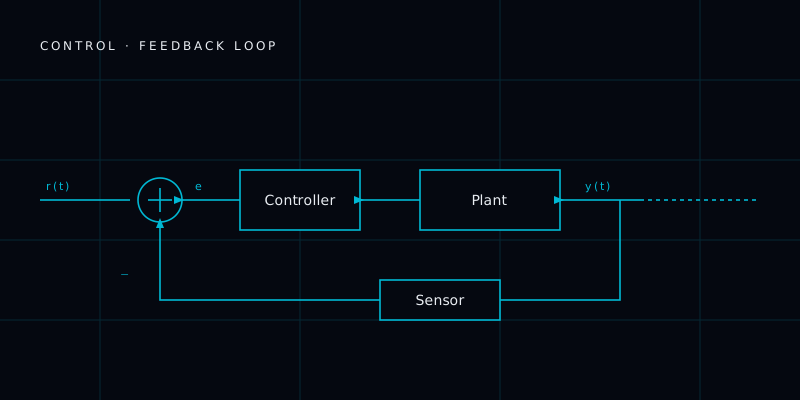
An adaptive controller couples a standard control law (e.g., PID or LQR) with a parameter-adjustment mechanism. The adjustment mechanism observes the tracking error and modifies the controller gains using a known update rule — for instance, the MIT rule or Model Reference Adaptive Control (MRAC). Over time, the gains converge to values appropriate for the current operating condition.
Real-world example
Aircraft autopilots use adaptive control to handle fuel burn-off changing aircraft weight. Robotic arms picking up unknown payloads use adaptive control to retune in real time. Tesla Autopilot's lane-keeping uses an adaptive component to handle different road surfaces.
Why it matters for robotics
Adaptive control is essential whenever conditions vary unpredictably. For real-world Indian robotics — where dust, humidity, and load vary daily — adaptive control is more practical than re-tuning PID gains every morning.
See also
Ask R2 Co-pilot anything you didn't understand about Adaptive Control in Robotics — Complete Guide. It'll explain it plainly.
Keep going
Feedback Loop in Robotics — Complete Guide
A feedback loop continuously measures a robot's output and adjusts its input to reach a desired target. It is …
ConceptModel Predictive Control (MPC) in Robotics — Complete Guide
MPC predicts future robot behaviour over a horizon and solves an optimisation problem to choose the best contr…
ConceptPID controller
A PID controller is a feedback algorithm that continuously corrects a robot's behaviour by measuring the gap b…
Last updated · 2026-05-21
Community discussion
0 questions & insightsLoading discussion…
Spotted something off? Report an error →