Bang-Bang Control in Robotics — Complete Guide
194 words · 1 min read
Bang-bang (on/off) control switches the actuator between two extremes — fully on or fully off — based on whether the output is above or below the setpoint.
The concept concept: Bang-bang (on/off) control switches the actuator between two
Difficulty 3/5 · ClassroomBang-bang control is the simplest closed-loop control law: if the measured value is below the setpoint, the actuator is fully on; otherwise it is fully off. It is also called on-off control, two-position control, or hysteresis control.
💡 Think of it like…
Think of it like a household object that does the same job — the underlying idea is the same, just adapted for robots.
Why it matters
Without bang-bang control in robotics — complete guide, many concept systems in robotics simply couldn't work.
Bang-Bang Control in Robotics
What is it?
Bang-bang control is the simplest closed-loop control law: if the measured value is below the setpoint, the actuator is fully on; otherwise it is fully off. It is also called on-off control, two-position control, or hysteresis control.
How it works
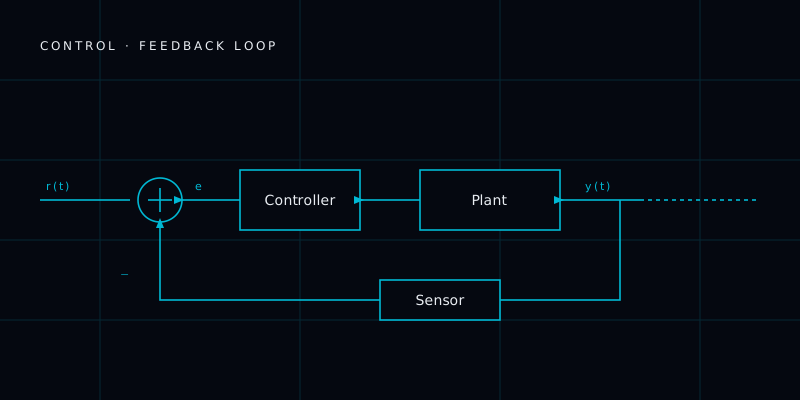
The controller compares the measured value to the setpoint. If error is positive, the actuator turns fully on; if error is negative, it turns fully off. To avoid rapid chattering near the setpoint, a hysteresis band is used — the actuator only switches when the error crosses outside a small dead zone around the setpoint.
Real-world example
Your home refrigerator is a bang-bang controller. So is most household heating. In robotics, a simple line-following robot toggles its motors fully left or fully right based on which IR sensor sees the line.
Why it matters for robotics
Bang-bang control is cheap, simple, and good enough for many tasks — perfect for first robotics projects. Indian students often start with bang-bang in their Arduino line-follower before moving to PID.
See also
Ask R2 Co-pilot anything you didn't understand about Bang-Bang Control in Robotics — Complete Guide. It'll explain it plainly.
Keep going
Closed-loop control
Closed-loop control uses sensor feedback to continuously compare what a robot is doing with what it should be …
ConceptFeedback Loop in Robotics — Complete Guide
A feedback loop continuously measures a robot's output and adjusts its input to reach a desired target. It is …
ConceptPID controller
A PID controller is a feedback algorithm that continuously corrects a robot's behaviour by measuring the gap b…
Last updated · 2026-05-21
Community discussion
0 questions & insightsLoading discussion…
Spotted something off? Report an error →