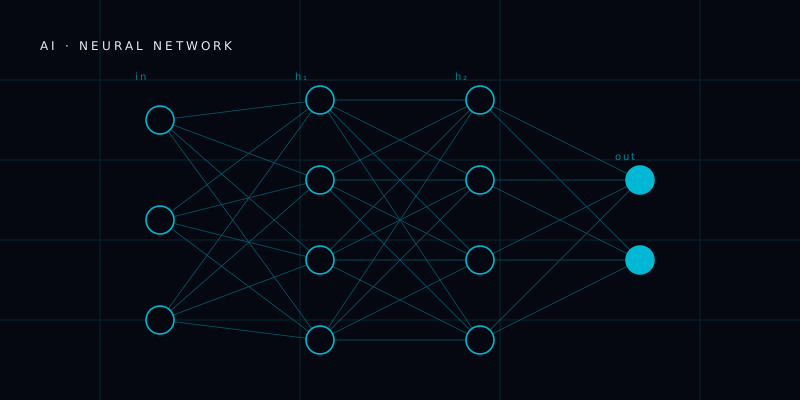
Behavior cloning teaches a robot a skill by training it to copy a human's demonstrations — the simplest form of imitation learning, powerful and direct, but with a famous compounding-error weakness.
Behavior cloning trains a robot to copy exactly what a human did in each situation — like learning to drive by memorizing 'when you see this, do that.' Simple and effective, but it struggles when the robot ends up somewhere the human never demonstrated.
The most direct way to teach a robot a skill is to show it, and have it copy you. That's behavior cloning — the simplest form of imitation learning, and a workhorse of modern robot skill acquisition.
How it works
Behavior cloning is plain supervised learning applied to actions. Collect demonstrations — a human teleoperating the robot, or driving, or performing a task — recording (observation → action) pairs. Then train a network to predict the demonstrator's action from each observation. At run time, the robot sees an observation and outputs the action it learned to associate with it. No reward function, no exploration — just "in this situation, do what the human did."
Copy the demonstrator
It's supervised learning: map what you see to what the expert did. Simple, direct, and effective when the robot stays near the demonstrated situations.
Why it's popular
Simple and effective. No reward engineering (reward shaping is hard), no risky exploration — just imitate. Fast to train with standard supervised methods.
Great with modern data. Paired with rich demonstration datasets (human teleoperation) and expressive policies like diffusion policies and transformers, behavior cloning drives much of today's learned manipulation and is the base of many Vision-Language-Action models.
The famous flaw: compounding error
Behavior cloning's classic weakness is distribution shift. The robot is only trained on the situations the expert visited. But the robot makes small mistakes, which take it to slightly-off states the demonstrations never covered — where it's more likely to err, taking it further off, and so on. Errors compound, and the robot can spiral into failure it was never shown how to recover from. (The textbook example: a self-driving policy trained only on centered-in-lane demos never learned how to recover once it drifts to the edge.)
The fixes
DAgger (Dataset Aggregation). Let the robot act, have the expert label the states the robot actually reached, add those to the data, retrain — teaching it recovery. Directly attacks the distribution-shift problem.
More and richer demonstrations, including recoveries and diverse situations.
Combine with RL. Use behavior cloning to bootstrap a policy, then refine with reinforcement learning to handle unseen states and improve beyond the demonstrator.
Learn intent, not just actions.Inverse reinforcement learning recovers the goal behind demonstrations, which generalizes better than copying actions.
Why it matters
Behavior cloning is the foundational, most-used way to turn human demonstrations into robot skills — the engine behind much of modern learned manipulation. Understanding both its power (simple, effective imitation) and its compounding-error weakness is essential to how robots learn from people today.