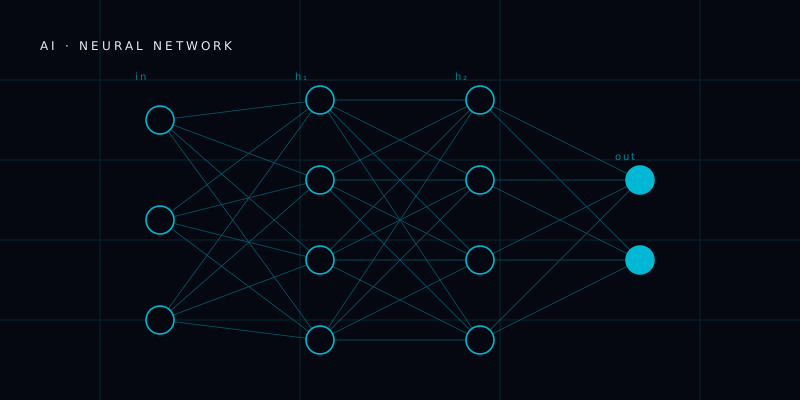
The Deep Q-Network fused Q-learning with deep neural networks, learning to act straight from raw pixels — the 2013 breakthrough that kicked off the deep reinforcement learning era and made RL viable for high-dimensional robot perception.
A Deep Q-Network replaces Q-learning's giant lookup table with a neural network, so it can handle huge inputs like camera images. It famously learned to play dozens of Atari games straight from the screen pixels, with no hand-coding.
Q-learning was elegant but stuck with a lookup table — useless for a robot whose "state" is a camera image. The Deep Q-Network broke that wall and launched modern deep reinforcement learning.
The leap
Replace the Q-table with a deep neural network that takes a raw observation (say, screen pixels) and outputs a Q-value for each action. Now the state can be enormous and high-dimensional — exactly what real perception looks like. Train the network toward the same Bellman target Q-learning uses, and it learns to act directly from perception.
In 2013–2015, DeepMind's DQN learned to play 49 Atari games from pixels alone, matching or beating humans on many, using one architecture and no game-specific tuning — the result that convinced the field deep RL was real.
Perception straight to action values
The network learns features and action values together, end to end — no hand-engineered state.
Two tricks that made it work
Naively combining neural nets with Q-learning is unstable. DQN added two now-standard fixes:
Experience replay — store past transitions in a buffer and train on random samples, breaking the harmful correlations of consecutive frames.
Target network — compute the learning target from a slowly-updated copy of the network, so the target doesn't chase a constantly-moving estimate and diverge.
Relevance to robots
DQN itself handles discrete actions, so it's a natural fit for decision-making but not for a robot's continuous joint torques. Its ideas, though — deep value approximation, replay, target networks — carry straight into the actor-critic and policy-gradient methods (DDPG, SAC) that do control continuous robots. DQN is the ancestor of the whole family.
Why it matters
The Deep Q-Network is the moment reinforcement learning met deep learning and scaled to raw perception. Every robot that learns from images or high-dimensional sensors builds on the door DQN opened.