Field-Oriented Control (FOC) in Robotics — Complete Guide | R2BOT
344 words · 2 min read
FOC is the dominant control technique for BLDC motors — turning a 3-phase motor into a smooth, torque-controllable actuator. Used in every EV, drone ESC, and modern robot joint.
The power electronics concept: FOC is the dominant control technique for BLDC
Field-Oriented Control (FOC), also called vector control, is a technique that transforms 3-phase motor currents into two perpendicular axes — direct (d) and quadrature (q). By controlling these axes independently, FOC delivers smooth torque, high efficiency, and instant response from BLDC and PMSM motors.
💡 Think of it like…
Think of it like a household object that does the same job — the underlying idea is the same, just adapted for robots.
Why it matters
Without field-oriented control (foc) in robotics — complete guide | r2bot, many power electronics systems in robotics simply couldn't work.
Field-Oriented Control (FOC) in Robotics
What is Field-Oriented Control (FOC) in Robotics?
Field-Oriented Control (FOC), also called vector control, is a technique that transforms 3-phase motor currents into two perpendicular axes — direct (d) and quadrature (q). By controlling these axes independently, FOC delivers smooth torque, high efficiency, and instant response from BLDC and PMSM motors.
How It Works
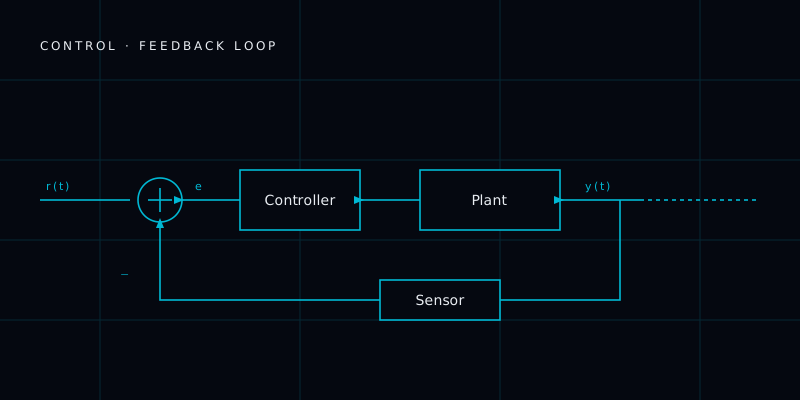
FOC uses the Clarke and Park transforms to convert measured phase currents (a, b, c) into rotor-frame components (d, q). The d-axis aligns with the rotor magnetic field; the q-axis is perpendicular. Torque is proportional to q-current, so torque control becomes a simple PI loop on q. Two PI controllers regulate d and q currents; their outputs go through inverse Park + space-vector PWM to generate the inverter switching pattern. Rotor angle for the transforms comes from Hall sensors, encoders, or sensorless back-EMF estimation.
Real-World Example
Tesla's drive inverters use FOC. Every quadcopter ESC uses FOC. Universal Robots cobots use FOC at every joint. VESC, the open-source motor controller from Benjamin Vedder, is built around FOC. Indian EV startups (Ola Electric, Ather, Bounce) all hire FOC firmware engineers.
Why It Matters for Robotics
Without FOC, BLDC motors deliver jerky torque and waste energy. With FOC, they become precision instruments. FOC is one of the most valuable specialised skills in modern robotics and EV engineering — Indian electric two-wheeler and drone companies are critically short of FOC engineers.
Try It Yourself
Clone the SimpleFOC library (Arduino-compatible). Wire a small gimbal motor, magnetic encoder, and BTS7960 driver. Run the FOC torque-control example and feel how a tiny commanded torque produces smooth rotation — your first FOC experience.
Quick Quiz
Quick Quiz
3 questions
1.FOC controls a 3-phase motor by transforming into:
2.In FOC, motor torque is proportional to:
3.FOC is the standard control method for:
Further Reading
Ask R2 About This
Open the R2 Co-pilot (press ⌘K anywhere on R2BOT) and ask: "Explain Field-Oriented Control (FOC) in Robotics for a Class 9 student in India, with one real-world Indian example." You'll get a tailored, sourced answer in seconds.
Ask R2 Co-pilot anything you didn't understand about Field-Oriented Control (FOC) in Robotics — Complete Guide | R2BOT. It'll explain it plainly.
Keep going
Brushless DC Motor (BLDC) in Robotics — Complete Guide
A BLDC motor uses electronic commutation instead of mechanical brushes. BLDC motors are highly efficient, dura…
ConceptH-Bridge Circuit in Robotics — Complete Guide
An H-bridge is a circuit of four transistors that lets a DC motor spin in either direction. It is the heart of…
ConceptMotor Driver in Robotics — Complete Guide
A motor driver is an electronic circuit that lets a low-power microcontroller control a high-power motor. The …
Last updated · 2026-05-21
Community discussion
0 questions & insightsLoading discussion…
Spotted something off? Report an error →