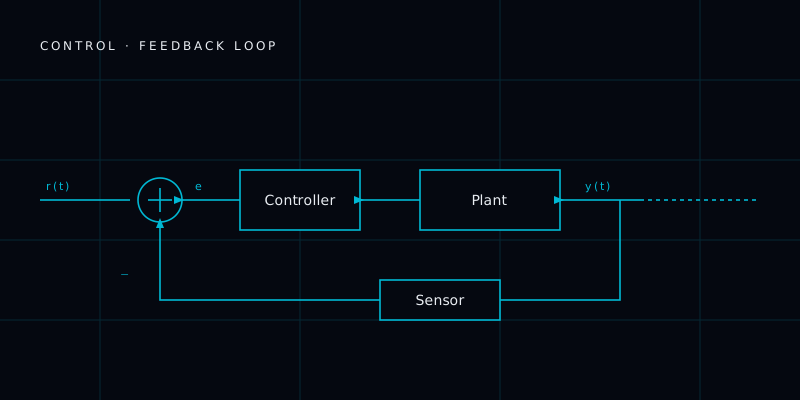
Hardware-in-the-loop testing connects a robot's real controller to a simulated world — so the actual electronics and software can be tested safely and repeatably against virtual sensors and physics before touching a real robot.
Hardware-in-the-loop testing plugs the robot's real control computer into a simulation. The controller thinks it's driving a real robot, but the sensors and world are simulated — so you can test the actual hardware and code safely, including crash scenarios.
🎯 Quick challenge
In hardware-in-the-loop testing, what is real and what is simulated?
There's a gap between pure software simulation and testing on a real robot. Hardware-in-the-loop (HIL) testing bridges it — putting the real controller into a simulated world.
What it is
In HIL, the robot's actual control hardware and software (the controller, its firmware, sometimes real sensors or motor drivers) runs for real — but instead of driving a physical robot, it's connected to a real-time simulation of the robot and its environment. The controller sends actuator commands; the simulation computes how the virtual robot would respond and feeds back simulated sensor readings. The controller can't tell it isn't driving a real machine.
Real controller, simulated robot
The embedded system runs exactly as it would on hardware, but the physics and sensors are simulated in real time — testing the real software/hardware safely.
Why it's valuable
Test the real thing, safely. Unlike pure software simulation, HIL validates the actual controller, firmware, and timing — bugs that only appear on real hardware — without risking an expensive robot or people.
Dangerous and edge cases. Deliberately simulate faults, extreme conditions, and failure scenarios (a sensor dropping out, a motor stalling) that would be dangerous or destructive to trigger on a real robot.
Repeatable and automated. Run the exact same scenario thousands of times for regression testing — impossible with a physical robot where every run differs.
Before hardware exists. Test the control system against a simulated robot while the physical one is still being built.
It demands a real-time simulation (often on a real-time operating system or dedicated HIL rig) because the controller runs in real time and expects timely responses.
Where it sits in the testing ladder
Software-in-the-loop (SIL) — everything, including the controller, runs as software; fastest, least real.
Hardware-in-the-loop (HIL) — real controller, simulated plant; validates the embedded system.
Real-robot testing — the final, highest-fidelity, highest-risk step.
HIL is the crucial middle rung, standard in automotive, aerospace, and increasingly robotics, feeding into the broader sim-to-real validation process.
Why it matters
Hardware-in-the-loop lets teams validate a robot's real control system thoroughly, safely, and repeatably — catching the bugs that pure simulation misses without endangering hardware or people. It's a key practice for building reliable, safety-critical robots and a bridge between simulation and deployment.