Image Segmentation in Robotics — Complete Guide | R2BOT
296 words · 2 min read
Image segmentation labels every pixel in an image with a class — essential for robot grasping, autonomous driving, and crop-disease detection.
The computer vision concept: Image segmentation labels every pixel in an image
Image segmentation labels every pixel of an image with a class — for example, 'road', 'sky', 'pedestrian', 'crop', 'weed'. In robotics it provides the fine-grained understanding needed to grasp irregular objects, follow lanes, or weed a field.
💡 Think of it like…
Think of it like a household object that does the same job — the underlying idea is the same, just adapted for robots.
Why it matters
Without image segmentation in robotics — complete guide | r2bot, many computer vision systems in robotics simply couldn't work.
Image Segmentation in Robotics
What is Image Segmentation in Robotics?
Image segmentation labels every pixel of an image with a class — for example, 'road', 'sky', 'pedestrian', 'crop', 'weed'. In robotics it provides the fine-grained understanding needed to grasp irregular objects, follow lanes, or weed a field.
How It Works
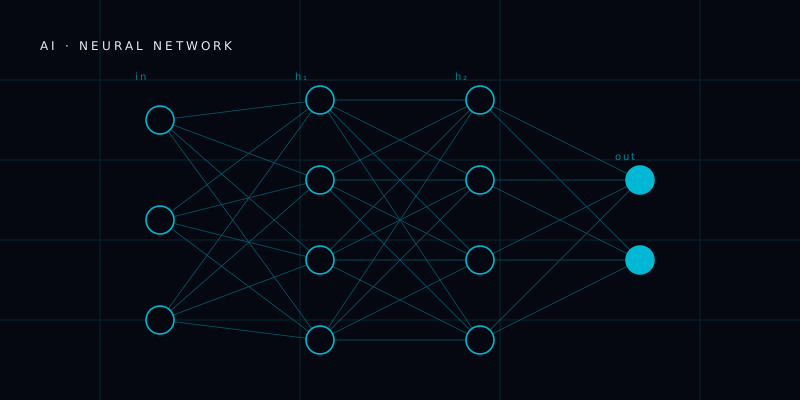
Modern segmentation uses fully-convolutional networks (FCNs) like U-Net, DeepLab, or SegFormer. The network takes an image and produces a per-pixel class map of the same resolution. Training uses pixel-labelled datasets (Cityscapes, COCO, ADE20K). For robotics, you typically fine-tune a pretrained model on a few hundred labelled images from your robot's camera. Inference runs at 10–100 FPS on Jetson-class devices.
Real-World Example
Tesla and Waymo use segmentation for drivable area and pedestrian detection. Niqo Robotics (India) uses segmentation to spot diseased rice plants. Hospital cleaning robots segment floors vs walls vs furniture. Warehouse robots segment shelves vs aisles vs people.
Why It Matters for Robotics
Segmentation gives robots dense scene understanding — every pixel labelled. It is one of the most commercially valuable CV techniques today. Indian computer-vision job interviews routinely test U-Net and segmentation evaluation metrics.
Try It Yourself
Open Google Colab. Load a pretrained U-Net or SegFormer from Hugging Face. Run it on an image from your phone of an Indian street and visualise the per-pixel labels. Notice where it fails — that is your data-collection target.
Quick Quiz
Quick Quiz
3 questions
1.Image segmentation produces:
2.U-Net is famous for being:
3.A typical use of segmentation in agritech is:
Further Reading
Ask R2 About This
Open the R2 Co-pilot (press ⌘K anywhere on R2BOT) and ask: "Explain Image Segmentation in Robotics for a Class 9 student in India, with one real-world Indian example." You'll get a tailored, sourced answer in seconds.
🐍 Python Playground · runs in your browser
Editor · 15 lines
Output
Press ▶ Run to execute. First run downloads Python (~6MB) — only happens once per page.
Powered by Pyodide · Python in WebAssembly · no server required.
Ask R2 Co-pilot anything you didn't understand about Image Segmentation in Robotics — Complete Guide | R2BOT. It'll explain it plainly.
Keep going
Computer vision (for robots)
Computer vision is how a robot makes sense of what its camera sees. It turns pixels into objects, distances, a…
ConceptConvolutional Neural Network (CNN) in Robotics — Complete Guide | R2BOT
CNNs are the workhorse neural architecture for robot vision. They power object detection, segmentation, and de…
ConceptObject detection
Object detection is an AI task where a computer identifies what objects are present in an image and draws a bo…
Last updated · 2026-05-21
Community discussion
0 questions & insightsLoading discussion…
Spotted something off? Report an error →