Kalman Filter in Robotics — Complete Guide | R2BOT
348 words · 2 min read
The Kalman filter optimally fuses noisy sensor data to estimate a robot's true state. Foundation of GPS+IMU fusion, SLAM, and tracking.
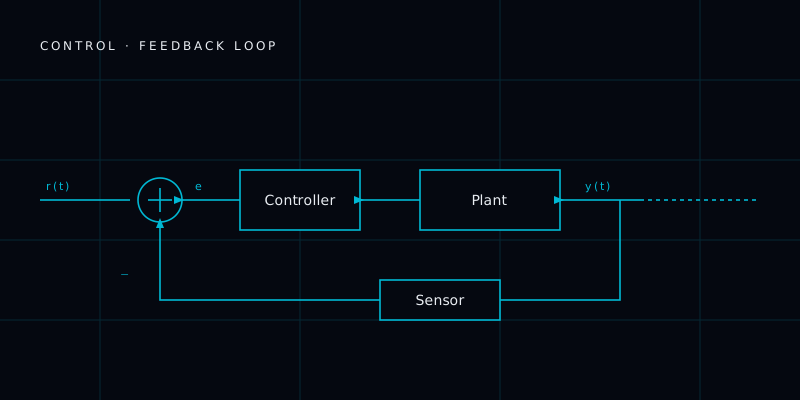
The control systems concept: The Kalman filter optimally fuses noisy sensor data
The Kalman filter is a mathematical algorithm that combines noisy measurements with a model of how a system evolves to produce the optimal estimate of the system's true state. In robotics, it fuses GPS, IMU, encoders, and other sensors to give one clean position and velocity.
💡 Think of it like…
Think of it like a household object that does the same job — the underlying idea is the same, just adapted for robots.
Why it matters
Without kalman filter in robotics — complete guide | r2bot, many control systems systems in robotics simply couldn't work.
Kalman Filter in Robotics
What is Kalman Filter in Robotics?
The Kalman filter is a mathematical algorithm that combines noisy measurements with a model of how a system evolves to produce the optimal estimate of the system's true state. In robotics, it fuses GPS, IMU, encoders, and other sensors to give one clean position and velocity.
How It Works
At each step the filter does two things. Predict: it uses a motion model (e.g., constant velocity) to advance its belief forward in time, growing the uncertainty. Update: when a new sensor reading arrives, it computes how much to trust the reading vs the prediction (the Kalman gain) and pulls the estimate toward the measurement. The math optimally minimises mean-squared error if the system is linear and noise is Gaussian. Implementations come in under 50 lines of Python — but tuning the process and measurement covariance matrices is its own art.
Real-World Example
Apollo 11's onboard computer used a Kalman filter to navigate to the Moon. Every modern drone autopilot (PX4, ArduPilot) uses one. Tesla Autopilot fuses radar, camera, and IMU with Kalman-family filters. Indian Mars Orbiter Mission used Kalman filters for its trajectory estimation.
Why It Matters for Robotics
If you want to do serious robotics — drones, autonomous cars, mobile robots — you must understand Kalman filtering. It comes up in every senior robotics interview in India. The Kalman filter is also a gateway to modern state-estimation methods like the EKF, UKF, and factor graphs.
Try It Yourself
Open /visualizer and load the Kalman demo: you can play with measurement noise, process noise, and watch the filter converge. Then implement a 1D position-velocity Kalman filter in Python (20 lines) on a noisy random-walk simulation.
Quick Quiz
Quick Quiz
3 questions
1.A Kalman filter combines:
2.The Kalman gain controls:
3.Standard Kalman filtering assumes:
Further Reading
Ask R2 About This
Open the R2 Co-pilot (press ⌘K anywhere on R2BOT) and ask: "Explain Kalman Filter in Robotics for a Class 9 student in India, with one real-world Indian example." You'll get a tailored, sourced answer in seconds.
🐍 Python Playground · runs in your browser
Editor · 15 lines
Output
Press ▶ Run to execute. First run downloads Python (~6MB) — only happens once per page.
Powered by Pyodide · Python in WebAssembly · no server required.
Ask R2 Co-pilot anything you didn't understand about Kalman Filter in Robotics — Complete Guide | R2BOT. It'll explain it plainly.
Keep going
Extended Kalman Filter in Robotics — Complete Guide | R2BOT
The Extended Kalman Filter (EKF) handles nonlinear motion and sensor models by local linearisation. The defaul…
ConceptGPS Module in Robotics — Complete Guide | R2BOT
A GPS module gives a robot its global position via satellites. Used in drones, autonomous cars, delivery bots,…
ConceptIMU (Inertial Measurement Unit)
An IMU is a chip that measures how fast something is accelerating and rotating. It is what lets a robot — or a…
Last updated · 2026-05-21
Community discussion
0 questions & insightsLoading discussion…
Spotted something off? Report an error →