LQR Controller in Robotics — Complete Guide | R2BOT
328 words · 2 min read
The Linear Quadratic Regulator (LQR) computes optimal feedback gains for linear systems. Used for inverted pendulums, drones, and gimbal stabilisation.
The control systems concept: The Linear Quadratic Regulator (LQR) computes optimal feedback
The Linear Quadratic Regulator (LQR) is an optimal control technique that computes the best feedback gains to balance state error against control effort. Given a linear system and a quadratic cost function, LQR solves a Riccati equation and gives you the optimal full-state feedback matrix.
💡 Think of it like…
Think of it like a household object that does the same job — the underlying idea is the same, just adapted for robots.
Why it matters
Without lqr controller in robotics — complete guide | r2bot, many control systems systems in robotics simply couldn't work.
LQR Controller in Robotics
What is LQR Controller in Robotics?
The Linear Quadratic Regulator (LQR) is an optimal control technique that computes the best feedback gains to balance state error against control effort. Given a linear system and a quadratic cost function, LQR solves a Riccati equation and gives you the optimal full-state feedback matrix.
How It Works
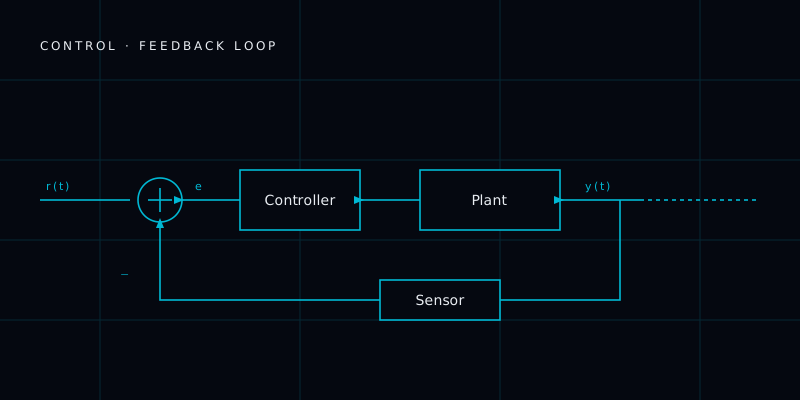
You start with a linear state-space model dx/dt = Ax + Bu. You pick two weighting matrices: Q penalises state error and R penalises control effort. The solution to the algebraic Riccati equation gives a matrix P from which the optimal gain K = R⁻¹BᵀP. The controller is then u = −Kx — every state variable is fed back with the right weight to minimise the cost. Tuning Q and R is the practical art: bigger Q means tighter tracking, bigger R means lower control effort.
Real-World Example
Boston Dynamics Atlas and Spot use LQR-family controllers for whole-body balance. Quadcopter autopilots often use LQR for attitude stabilisation. Camera gimbal stabilisation (DJI, Insta360) uses LQR or LQR+MPC. ISRO uses LQR-derived controllers for satellite attitude control.
Why It Matters for Robotics
LQR is the gateway from PID to modern multivariable optimal control. Any robotics graduate programme and many senior roles ask about LQR design. Mastering LQR — its assumptions, limitations, and tuning — opens the door to MPC, robust control, and model-based RL.
Try It Yourself
Simulate an inverted pendulum in Python using SciPy. Compute the LQR gain using scipy.linalg.solve_continuous_are. Plot the pendulum stabilising with Q = diag(10,1,10,1), then try doubling each weight and watch how the response changes.
Quick Quiz
Quick Quiz
3 questions
1.LQR finds the optimal feedback gain that minimises:
2.LQR assumes the system is:
3.Increasing the matrix Q in LQR generally:
Further Reading
Ask R2 About This
Open the R2 Co-pilot (press ⌘K anywhere on R2BOT) and ask: "Explain LQR Controller in Robotics for a Class 9 student in India, with one real-world Indian example." You'll get a tailored, sourced answer in seconds.
🐍 Python Playground · runs in your browser
Editor · 15 lines
Output
Press ▶ Run to execute. First run downloads Python (~6MB) — only happens once per page.
Powered by Pyodide · Python in WebAssembly · no server required.
Ask R2 Co-pilot anything you didn't understand about LQR Controller in Robotics — Complete Guide | R2BOT. It'll explain it plainly.
Keep going
Feedback Loop in Robotics — Complete Guide
A feedback loop continuously measures a robot's output and adjusts its input to reach a desired target. It is …
ConceptModel Predictive Control (MPC) in Robotics — Complete Guide
MPC predicts future robot behaviour over a horizon and solves an optimisation problem to choose the best contr…
ConceptPID controller
A PID controller is a feedback algorithm that continuously corrects a robot's behaviour by measuring the gap b…
Last updated · 2026-05-21
Community discussion
0 questions & insightsLoading discussion…
Spotted something off? Report an error →