Nav2 is the ROS 2 navigation stack — the batteries-included framework that takes a mobile robot from "go to that point" to actually driving there safely, handling localization, planning, obstacle avoidance, and recovery.
Nav2 is a ready-made navigation brain for wheeled robots on ROS 2. You give it a goal and a map, and it figures out where the robot is, plans a route, avoids obstacles as it drives, and recovers if it gets stuck.
Getting a mobile robot to reliably drive across a building involves localization, mapping, planning, obstacle avoidance, and error recovery — a huge amount to build from scratch. Nav2 provides it all as an integrated ROS 2 framework.
What it ties together
Nav2 orchestrates the whole navigation pipeline:
Localization — where am I on the map? (typically Monte Carlo localization/AMCL, or a SLAM source).
Global planning — a route from here to the goal across the map (A*, Hybrid-A*, and other Smac planners).
Local planning / control — moment-to-moment commands that follow the route while dodging obstacles.
Costmaps — layered representations of where it's safe to drive, updated live from sensors.
Recovery behaviors — what to do when stuck (back up, spin, clear the costmap, re-plan).
From goal to safe motion
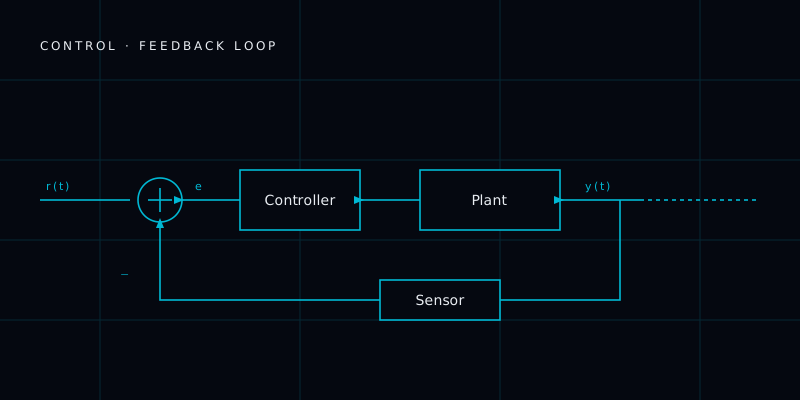
Nav2 runs the full loop continuously: localize, plan, follow, and — if things go wrong — trigger recovery, all coordinated by a behavior tree.
The behavior-tree brain
A defining feature of Nav2 is that its high-level logic is a behavior tree — a flexible, editable structure deciding "plan, then follow; if blocked, try recovery A, then B." This makes the navigation logic configurable without rewriting code, and is why Nav2 can be tailored from a warehouse robot to a sidewalk delivery bot.
Why it matters in practice
Nav2 is the de-facto standard for ROS 2 mobile-robot navigation, battle-tested on real fleets (its predecessor drove a robot a full marathon distance autonomously). Using it, a team configures planners, tunes costmap layers and robot footprint, and exposes navigation as a ROS action — rather than reinventing the entire stack. It's commanded simply: send a NavigateToPose goal and monitor progress.
Why it matters
Nav2 turns "make my robot navigate" from a multi-year project into a configuration exercise. It packages decades of navigation research into a maintained, production framework — the foundation most ROS 2 mobile robots build on.