Planetary Gearbox in Robotics — Complete Guide | R2BOT
330 words · 2 min read
Planetary gearboxes deliver high torque and compact size for robot motors. Standard in cobots, drones, and consumer robotics.
The actuators concept: Planetary gearboxes deliver high torque and compact size
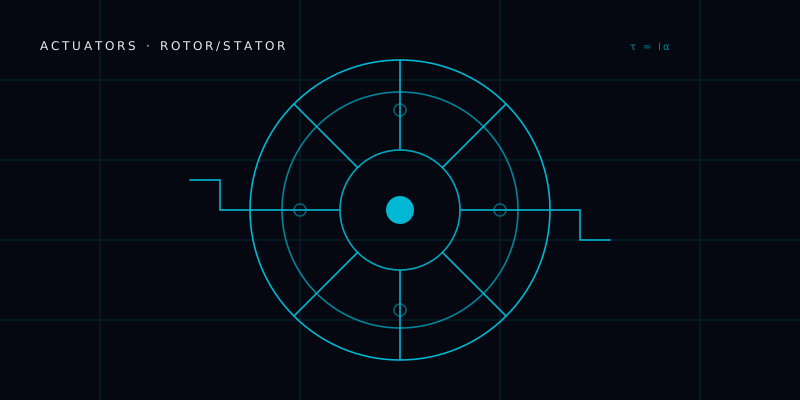
A planetary gearbox uses a sun gear, multiple planet gears, and an outer ring gear to transmit torque with high reduction in a compact, coaxial package. Robots love planetary gearboxes because they deliver high torque from a small motor without the mass or cost of a harmonic drive.
💡 Think of it like…
Think of it like a household object that does the same job — the underlying idea is the same, just adapted for robots.
Why it matters
Without planetary gearbox in robotics — complete guide | r2bot, many actuators systems in robotics simply couldn't work.
Planetary Gearbox in Robotics
What is Planetary Gearbox in Robotics?
A planetary gearbox uses a sun gear, multiple planet gears, and an outer ring gear to transmit torque with high reduction in a compact, coaxial package. Robots love planetary gearboxes because they deliver high torque from a small motor without the mass or cost of a harmonic drive.
How It Works
The central sun gear is driven by the motor. It meshes with three or more planet gears that orbit it; the planets in turn mesh with the inner teeth of a fixed outer ring. The planets are mounted on a carrier that becomes the output shaft. Because torque is shared across all planets, the gearbox handles big loads with even smaller teeth than a parallel-shaft gear. Reduction ratios of 3:1 to 100:1 are common in a single stage; multiple stages can be cascaded.
Real-World Example
Every DJI drone motor has a small planetary reduction. Boston Dynamics Spot's leg actuators include planetary stages. The motors inside Universal Robots cobots combine planetary gearboxes with harmonic drives. Even Tesla Model 3's motor uses planetary reduction for the wheels.
Why It Matters for Robotics
Planetary gearboxes are the workhorse reduction technology — cheaper than harmonic, smaller than parallel. Indian robotics startups source them from Maxon, Faulhaber, and increasingly Indian players like Bonfiglioli India. Selecting the right reduction is one of the most common robotics design tasks.
Try It Yourself
Buy a 12V Pololu metal-gearmotor with 30:1 planetary reduction (~₹1,000). Compare its torque against a raw motor without the gearbox — drive a small chassis and feel the difference when you grab the wheel by hand.
Quick Quiz
Quick Quiz
3 questions
1.A planetary gearbox has these three core gear types:
2.Why is a planetary gearbox compact for its torque?
3.A typical single-stage planetary reduction is:
Further Reading
Ask R2 About This
Open the R2 Co-pilot (press ⌘K anywhere on R2BOT) and ask: "Explain Planetary Gearbox in Robotics for a Class 9 student in India, with one real-world Indian example." You'll get a tailored, sourced answer in seconds.
Ask R2 Co-pilot anything you didn't understand about Planetary Gearbox in Robotics — Complete Guide | R2BOT. It'll explain it plainly.
Keep going
Brushless DC Motor (BLDC) in Robotics — Complete Guide
A BLDC motor uses electronic commutation instead of mechanical brushes. BLDC motors are highly efficient, dura…
ConceptDC motor
A DC motor converts direct-current electricity into continuous spinning motion. Feed it voltage, it turns; rev…
ConceptHarmonic Drive in Robotics — Complete Guide | R2BOT
Harmonic drive gears deliver huge reduction with near-zero backlash in a compact package. Standard in robotic …
Last updated · 2026-05-21
Community discussion
0 questions & insightsLoading discussion…
Spotted something off? Report an error →