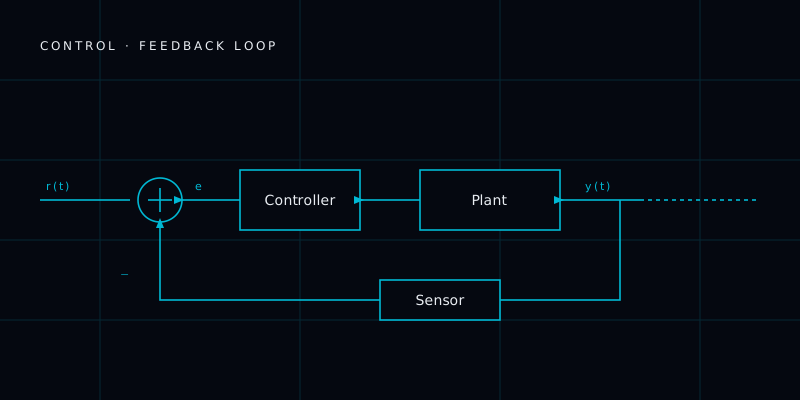
Pole placement is a control design method that chooses feedback gains to put a system's poles exactly where you want them — directly dialing in how fast and how smoothly a robot settles.
Pole placement lets a designer decide exactly how quickly and smoothly a robot returns to its target after a disturbance, by choosing feedback gains that set the system's "poles" — the numbers that govern its response.
A control system's poles are the numbers that govern its personality: whether it settles fast or slow, smoothly or with overshoot, stable or not. Pole placement is the design method that lets you put them exactly where you want.
What it is
For a system written in state-space form (ẋ = Ax + Bu), full-state feedback uses u = -Kx. That changes the system's dynamics to (A - BK), whose eigenvalues are the closed-loop poles. Pole placement solves the reverse problem: pick the poles you want (from your desired settling time and damping), then compute the gain K that produces them.
From desired response to feedback gains
Choose how fast/smooth you want the response, translate that into pole positions, and pole placement hands you the exact gains.
The intuition
Poles further left (more negative real part) mean a faster response. Poles near the imaginary axis mean slow; poles with large imaginary parts mean oscillatory. So placing poles is really placing behavior: "settle in 0.5 s with slight damping" becomes a specific pair of pole locations, which becomes a specific K.
Pole placement vs LQR
Pole placement gives you direct control over the response but leaves you guessing at good pole locations for complex, multi-input systems — push a pole too far left and you demand huge, actuator-saturating gains. LQR instead lets you specify what you value (error vs effort) and computes well-behaved gains automatically; its poles land wherever the optimal trade-off puts them. Many engineers use pole placement for intuition and simple systems, LQR for serious multivariable ones. Both need the full state, so both pair with a state observer.
Why it matters
Pole placement is the clearest illustration of the core idea of state feedback: that with the right gains you can reshape a robot's dynamics almost at will. It's foundational for understanding stability, response tuning, and why controllability matters.