Sliding Mode Control in Robotics — Complete Guide | R2BOT
336 words · 2 min read
Sliding mode control drives a robot onto a chosen "sliding surface" with strong disturbance rejection. Robust but prone to chattering.
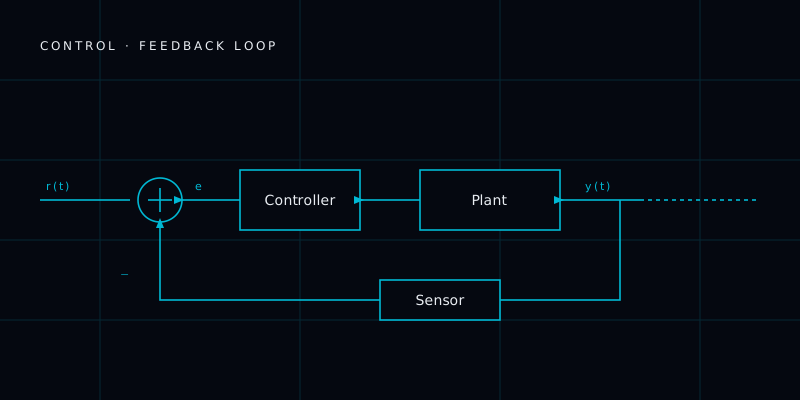
The control systems concept: Sliding mode control drives a robot onto a
Sliding mode control is a robust nonlinear control technique that forces the system state onto a designer-chosen surface in state space, then keeps it sliding along that surface to the target. It is famously robust to large disturbances and unmodelled dynamics.
💡 Think of it like…
Think of it like a household object that does the same job — the underlying idea is the same, just adapted for robots.
Why it matters
Without sliding mode control in robotics — complete guide | r2bot, many control systems systems in robotics simply couldn't work.
Sliding Mode Control in Robotics
What is Sliding Mode Control in Robotics?
Sliding mode control is a robust nonlinear control technique that forces the system state onto a designer-chosen surface in state space, then keeps it sliding along that surface to the target. It is famously robust to large disturbances and unmodelled dynamics.
How It Works
First you design a sliding surface — a function s(x) that equals zero exactly when the system has the desired behaviour. Then you design a control law that drives s(x) toward zero in finite time, typically using a switching term sign(s) multiplied by a gain. Once s = 0, the system slides along the surface to the goal. The switching term gives the controller's strong robustness to disturbances but also causes 'chattering' — high-frequency oscillation around the surface — which must be mitigated with boundary layers or super-twisting algorithms.
Real-World Example
Sliding-mode controllers stabilise nuclear-reactor control rods, electric-motor drives, and hydraulic manipulators. Quadcopters subject to wind gusts use sliding-mode attitude control. Tesla Model S Plaid's motor inverters use sliding-mode-derived schemes for high-bandwidth torque control.
Why It Matters for Robotics
When you cannot accurately model the system or expect heavy disturbances, sliding-mode is one of the most robust control techniques available. It is a standard topic in PhD-level robotics curricula and appears regularly in defence and aerospace robotics careers in India (DRDO, ISRO, BrahMos).
Try It Yourself
Simulate a 2nd-order system in Simulink or Python with a sliding-mode controller. Add a step disturbance and compare the response to a PID controller — feel the trade-off between robustness and chattering.
Quick Quiz
Quick Quiz
3 questions
1.Sliding-mode control drives the system to behave along a:
2.A known problem with classical sliding-mode controllers is:
3.Sliding-mode control is most attractive when:
Further Reading
Ask R2 About This
Open the R2 Co-pilot (press ⌘K anywhere on R2BOT) and ask: "Explain Sliding Mode Control in Robotics for a Class 9 student in India, with one real-world Indian example." You'll get a tailored, sourced answer in seconds.
🐍 Python Playground · runs in your browser
Editor · 15 lines
Output
Press ▶ Run to execute. First run downloads Python (~6MB) — only happens once per page.
Powered by Pyodide · Python in WebAssembly · no server required.
Ask R2 Co-pilot anything you didn't understand about Sliding Mode Control in Robotics — Complete Guide | R2BOT. It'll explain it plainly.
Keep going
Feedback Loop in Robotics — Complete Guide
A feedback loop continuously measures a robot's output and adjusts its input to reach a desired target. It is …
ConceptModel Predictive Control (MPC) in Robotics — Complete Guide
MPC predicts future robot behaviour over a horizon and solves an optimisation problem to choose the best contr…
ConceptPID controller
A PID controller is a feedback algorithm that continuously corrects a robot's behaviour by measuring the gap b…
Last updated · 2026-05-21
Community discussion
0 questions & insightsLoading discussion…
Spotted something off? Report an error →