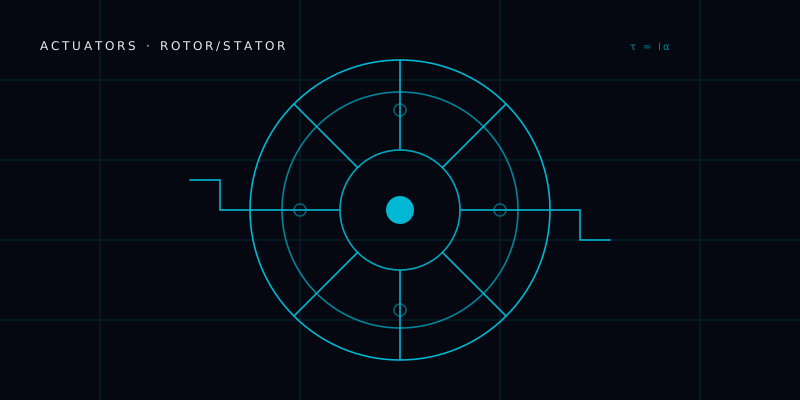
A slip ring carries power and signals across a continuously rotating joint — the component that lets a spinning lidar, a turret, or a rotating robot part turn forever without twisting and snapping its cables.
A slip ring is a rotating electrical connector. It lets electricity and signals pass from a still part of a robot to a spinning part, so something can rotate endlessly without its wires wrapping up and breaking.
Here's a deceptively hard problem: how do you power and read data from something that spins around forever? A spinning lidar or a rotating turret can't have normal wires — they'd wind up and snap. The elegant fix is the slip ring.
What it is
A slip ring is a rotary electrical connector. It has conductive rings on the rotating part and stationary brushes (or other contacts) that press against them. As the part spins, the brushes stay in continuous electrical contact with the rings, so power and signals pass across the rotating joint without any fixed wire spanning it. The result: something can rotate endlessly in one direction while staying electrically connected.
Electricity across a spinning joint
Rings turn with the rotating part while brushes stay put, maintaining contact — so the spinning side gets continuous power and data without twisting cables.
Where robots need it
Spinning lidar. A mechanical lidar rotates its laser assembly continuously; a slip ring powers it and carries the data out.
Turrets and pan mechanisms. Cameras, sensors, and weapons mounts that need to rotate without limit.
Rotary tables and tool changers in industrial cells.
Cable-management relief. Anywhere a joint would otherwise have to reverse to avoid winding up its wires, a slip ring removes that limit.
The trade-offs
Wear. Brushes and rings physically rub, so they wear over time and eventually need service — a maintenance item.
Noise and resistance. The sliding contact can add electrical noise and small resistance, a concern for sensitive signals (mitigated with gold contacts, or by using contactless rotary transfer for data).
Cost and size for high channel counts or high currents.
Alternatives exist for specific needs: rotary transformers for power and optical rotary joints or wireless for data, avoiding physical contact — but the classic brush slip ring remains simple and widely used.
Why it matters
The slip ring is the unsung component that makes continuous rotation electrically possible — the reason a lidar can spin, a turret can turn without end, and a robot joint can rotate freely without cable-wind limits. It's a small part that quietly enables a whole class of rotating robot mechanisms.