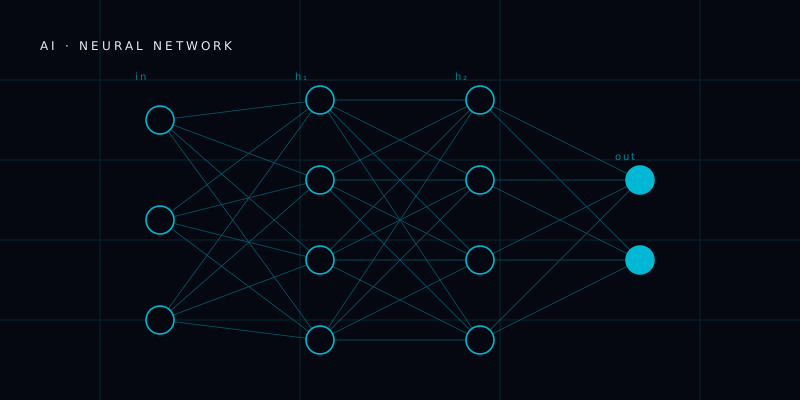
Visual grasp detection uses a neural network to predict where to grip an object straight from a camera or depth image — the learning-based approach that lets robots pick up objects they've never seen, in cluttered real-world bins.
Visual grasp detection is a robot looking at an object with a camera and a neural network instantly suggesting where to grab it — even for objects it has never seen before, without needing a 3D model.
🎯 Quick challenge
The big advantage of learned visual grasp detection is that it…
Classic grasp planning needs a model of the object. But a warehouse robot faces endless unfamiliar items in messy piles. Visual grasp detection — learning to grasp straight from images — is how modern robots handle that reality.
The idea
Feed a camera or depth image to a neural network trained on huge numbers of grasps, and it predicts where and how to grip — typically an antipodal grasp described by a position, approach angle, and gripper width — often with a success probability for each candidate. No per-object CAD model, no hand-tuned geometry: the network has learned what good grasps look like directly from data.
Image in, grasp out
The network maps pixels to grasp poses and confidence scores, so the robot can grip a novel object it has no model of.
Why it changed manipulation
Novel objects. It generalizes to items never seen in training — essential for the open-ended variety of real bins and homes.
Clutter. Trained on messy scenes, it finds graspable spots amid overlapping, partly hidden objects.
Speed. One forward pass yields grasps in milliseconds, fast enough for high-throughput picking.
Scales with data. Systems like Dex-Net trained on millions of simulated grasps and transferred to real robots; others learn from real robot attempts. More data, better grasping.
How it's trained
Two main data sources: simulation (generate objects, physically simulate grasp outcomes, label success — cheap and vast, but with a sim-to-real gap) and real robot self-supervision (let robots attempt thousands of grasps and learn from what held). Depth images are especially common because grasping is fundamentally about geometry.
The limits
It inherits perception's weaknesses — transparent, reflective, or deformable objects are hard — and a predicted grasp can still fail on contact, so robust systems verify the hold (force sensing) and retry. It's usually paired with a reachability and collision check before executing.
Why it matters
Visual grasp detection is the practical engine of modern robotic picking — the reason robots can now empty a bin of arbitrary objects. It moved grasping from "needs a model of everything" to "look and grab," and it's foundational to warehouse automation and general-purpose manipulation.