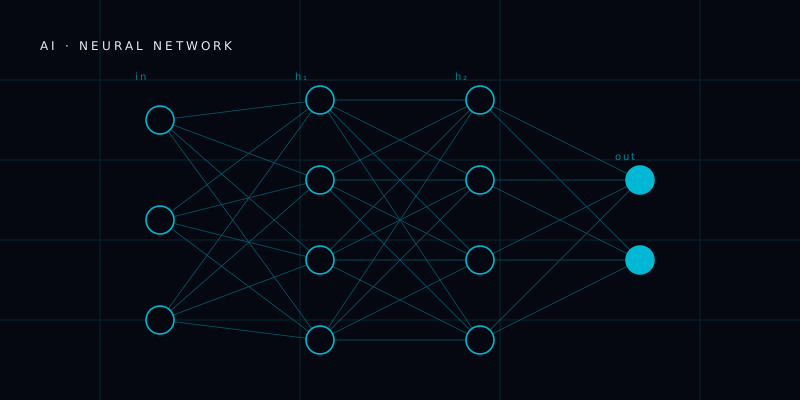
A world model is a neural network that learns to predict how the world changes — letting a robot 'imagine' the outcomes of its actions and plan or learn inside its own head, a fast-rising approach to sample-efficient robot learning.
A world model is an AI that learns how the world works well enough to predict what happens next. A robot with one can 'imagine' the results of its actions internally and plan, instead of having to try everything for real — which makes learning much faster.
What if a robot could imagine what would happen if it took an action — before actually doing it? That's the promise of a world model: a learned simulator of reality inside the robot's own network, and one of the most exciting directions in robot learning.
The idea
A world model is a neural network trained to predict how the environment changes: given the current state and an action, what state (and reward) comes next? Once it has learned the dynamics, the robot can run this model forward in its "imagination" — simulating the consequences of possible action sequences internally, without touching the real world. It can then plan (search for good action sequences) or learn a policy entirely inside the model.
Learn to predict, then imagine
The robot learns a predictive model from real experience, then uses it to simulate futures internally — planning and learning far more cheaply than acting for real each time.
Why it matters for robots
Sample efficiency.Model-free reinforcement learning needs enormous amounts of trial-and-error, which is expensive and slow on real robots. A world model lets the robot generate vast "imagined" experience from limited real data — model-based RL (Dreamer and successors) learns policies with far fewer real interactions.
Planning. With a predictive model, a robot can look ahead and choose actions that lead to good imagined outcomes — connecting to model predictive control, now with a learned model instead of hand-derived physics.
Generalization and reasoning. Rich world models capture intuitive physics and object relationships, a step toward robots that understand and reason about their environments.
The frontier
World models have exploded recently. Large video-and-action world models learn to predict future video frames conditioned on actions, effectively learning a general simulator of the physical world from data — a foundation for general robot policies. Powered by transformers and diffusion, they're a leading bet for scalable, sample-efficient, generalizable robot intelligence — some researchers see them as central to the path toward broadly capable robots.
The challenges
Compounding error. Small prediction errors accumulate over long imagined rollouts, so the robot's "imagination" can drift from reality — limiting how far ahead it can trust.
Modeling contact and the unpredictable. The hardest physics (contact, other agents) is also hardest to predict.
Compute. Rich world models are large and expensive to train and run.
Why it matters
The world model reframes robot learning from "try everything in the real world" to "learn how the world works, then think." It's a powerful route to sample-efficient, planning-capable, and increasingly general robots — and one of the most active frontiers in AI for robotics.