Compliant assembly lets a robot fit parts together by being deliberately soft — yielding to contact so pieces self-align instead of jamming — the key to automating insertion, mating, and fastening tasks.
Compliant assembly is a robot being gently springy while it fits parts together, so a piece can slide and settle into place when it's slightly off — instead of a rigid robot forcing it and jamming or breaking it.
The secret to a robot fitting parts together isn't precision — it's softness. Compliant assembly is the principle that a robot should yield to contact, letting parts guide themselves into place.
The core insight
When two parts mate — a peg in a hole, a connector in a socket, a bearing on a shaft — perfect alignment is impossible, and a rigid robot forcing them together jams or breaks them. A compliant robot instead gives way to the contact forces. As the parts touch, those forces naturally nudge the pieces toward alignment, and the soft robot follows, so the part slides into place. It's how a person wiggles a key into a stiff lock without thinking.
Let contact guide alignment
Compliance turns contact from an enemy (jamming) into a helper — the forces of contact do the fine alignment the robot can't sense precisely.
Two kinds of compliance
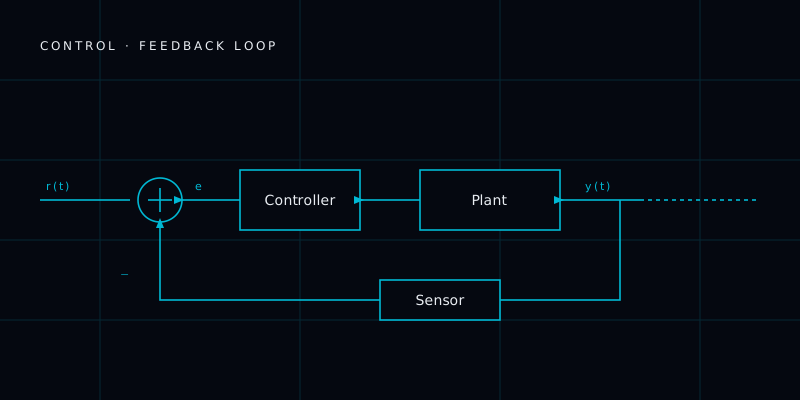
Active compliance — the robot behaves soft through control: impedance or admittance control, using a force-torque sensor to react to contact. Flexible and tunable — the robot can be stiff for approach and soft for insertion.
Passive compliance — mechanical give built into the hardware, like a remote center of compliance device or series-elastic joints. No sensing or computation needed; it just works, and fast — but it's fixed, not adjustable.
Many systems combine both: passive give for speed and robustness, active control for adaptability.
Why it matters for automation
Assembly — not just moving parts but fitting them — is a huge share of manufacturing that resisted automation precisely because rigid robots jam. Compliance (with force control and, increasingly, learned insertion policies) is what finally makes robotic assembly reliable: inserting connectors, seating bearings, threading fasteners, mating housings. The canonical test is peg-in-hole.
Why it matters
Compliant assembly reframes contact from a hazard to be avoided into a tool to be used. It's the enabling idea behind robotic assembly and any contact-rich task, and a core reason force control and soft actuation matter so much in modern manipulation.