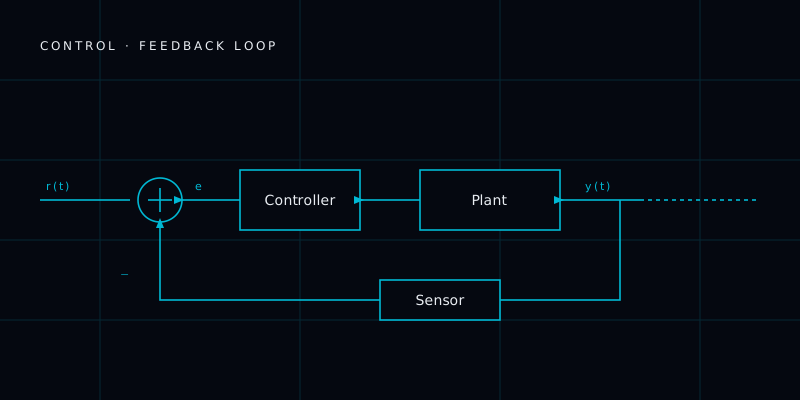
Peg-in-hole is the classic robotic assembly benchmark — inserting a part into a tight opening — that looks trivial but demands force sensing and compliance, because pure position control jams the moment anything is slightly misaligned.
Peg-in-hole is a robot fitting a pin into a hole — like putting a key in a lock. It seems easy, but if the pin is even a hair off-center it jams, so the robot has to feel the contact and gently wiggle it in.
🎯 Quick challenge
Why is peg-in-hole hard for a position-only robot?
Putting a peg in a hole is a toddler's toy — and one of the most famous hard problems in robotic assembly. Peg-in-hole is the benchmark that exposes why manipulation is more than moving to coordinates.
Why it's deceptively hard
A robot arm knows its position to fractions of a millimeter, so surely it can just move the peg to the hole? No — because the fits are tight (microns of clearance) and perception is never that precise. If the peg is even slightly off-center or tilted, pushing straight down jams it, wedging the peg against the hole's edge. A rigid, position-controlled robot then either stalls or breaks something. The problem isn't reaching the hole; it's the contact once you're there.
Feel your way in
Success comes from reacting to contact forces — letting the peg slide and self-align — not from commanding an exact rigid path.
How robots actually do it
The winning idea is to use contact forces, not fight them:
Force sensing. A force-torque sensor at the wrist feels how the peg is contacting the hole's edge, revealing which way it's misaligned.
Compliance.Impedance or admittance control makes the arm soft, so the peg can slide and settle into the hole instead of jamming — the essence of compliant assembly.
Search strategies. Spiral or wiggle motions plus tilt-then-straighten sequences that reliably find and enter the hole.
Passive help. A mechanical remote center of compliance device lets the peg self-align without any control at all.
Learning. Reinforcement and imitation learning now train contact-rich insertion policies directly.
Why it's a benchmark
Peg-in-hole distills the core challenges of contact-rich manipulation: tight tolerances, unmodeled friction, and the need to blend position with force. Success on it demonstrates the skills every assembly task needs — which is why it's the standard test for new manipulation and force-control methods.
Where you'll see it
Electronics assembly (connectors, chips), mechanical assembly (bearings, shafts, fasteners), and any insertion or mating operation on a production line.
Why it matters
Peg-in-hole is the gateway to robotic assembly — the moment a robot stops just moving parts and starts fitting them together. Mastering it, through force control and compliance, is essential to automating manufacturing beyond simple pick-and-place.