Fuzzy Logic in Robotics — Complete Guide
193 words · 1 min read
Fuzzy logic replaces strict true/false rules with degrees of truth. In robotics it enables natural-language control rules — useful when precise mathematical models aren't available.
The concept concept: Fuzzy logic replaces strict true/false rules with degrees
Difficulty 3/5 · ClassroomFuzzy logic is a form of many-valued logic where variables can take any value between 0 (false) and 1 (true). In robotics, it lets engineers write controllers in human-friendly rules like 'if distance is close and speed is fast, brake hard.'
💡 Think of it like…
Think of it like a household object that does the same job — the underlying idea is the same, just adapted for robots.
Why it matters
Without fuzzy logic in robotics — complete guide, many concept systems in robotics simply couldn't work.
Fuzzy Logic in Robotics
What is it?
Fuzzy logic is a form of many-valued logic where variables can take any value between 0 (false) and 1 (true). In robotics, it lets engineers write controllers in human-friendly rules like 'if distance is close and speed is fast, brake hard.'
How it works
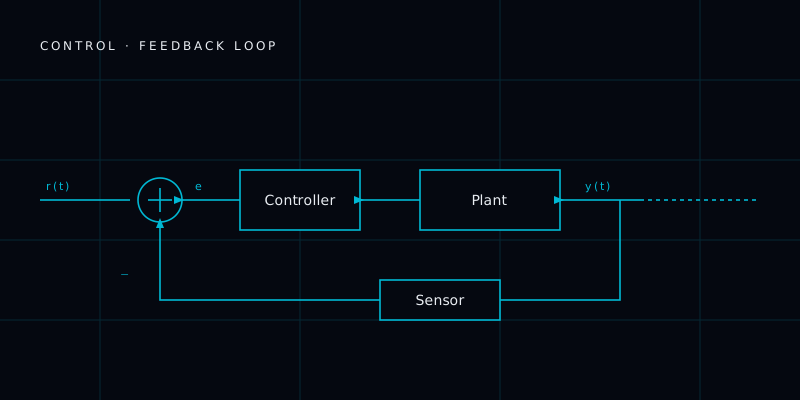
A fuzzy controller has three stages. First, fuzzification converts numeric inputs (e.g., distance = 1.2 m) into linguistic categories (near, medium, far) with overlapping membership functions. Next, a rule base of if-then rules evaluates the inputs. Finally, defuzzification converts the rule outputs back into a single numeric command.
Real-world example
Modern washing machines use fuzzy logic to decide cycle length based on load weight and dirt level. Camera autofocus uses it. Many Indian autonomous-rickshaw research projects use fuzzy logic to handle messy traffic conditions.
Why it matters for robotics
Fuzzy logic is invaluable when classical control models fail — for example, in highly non-linear or human-driven environments. It is a great bridge between symbolic AI and continuous control, and a common exam topic in Indian engineering curricula.
See also
Ask R2 Co-pilot anything you didn't understand about Fuzzy Logic in Robotics — Complete Guide. It'll explain it plainly.
Keep going
Adaptive Control in Robotics — Complete Guide
Adaptive control automatically adjusts its parameters as the robot operates — handling changing payloads, fric…
ConceptPID controller
A PID controller is a feedback algorithm that continuously corrects a robot's behaviour by measuring the gap b…
ConceptState machine
A state machine is a way of organising a robot's behaviour into distinct modes — called states — with clear ru…
Last updated · 2026-05-21
Community discussion
0 questions & insightsLoading discussion…
Spotted something off? Report an error →