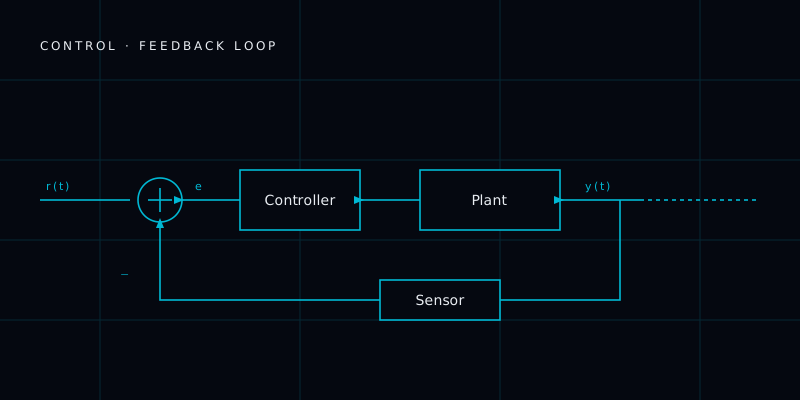
Gain scheduling runs different controller tunings for different operating conditions and blends between them — a practical way to control a robot whose behavior changes with speed, load, or configuration.
Gain scheduling keeps a set of controller tunings, each best for a different situation — slow vs fast, light vs heavy — and switches or blends between them as conditions change, like a car shifting gears.
🎯 Quick challenge
Gain scheduling changes the controller gains based on…
A controller tuned perfectly for a drone hovering may be sluggish at high speed; gains that balance a light robot arm may be too weak when it grabs a heavy payload. Gain scheduling is the pragmatic fix: keep several tunings and use the right one for the moment.
The idea
Divide the robot's operating range into regions, design a good linear controller (a PID or LQR) for each, and switch or smoothly interpolate between them based on a measured scheduling variable — airspeed, joint angle, payload mass, rotor RPM.
Pick the controller that fits the moment
As the scheduling variable changes, the effective controller changes with it — approximating one nonlinear controller with a family of linear ones.
Why it's everywhere
Gain scheduling is one of the oldest and most widely deployed nonlinear control techniques in the real world — it flies in virtually every aircraft autopilot and runs in countless industrial and robotic systems. It's popular because it's intuitive and reuses the entire toolbox of well-understood linear design. You don't need a fancy nonlinear proof; you need good local controllers and a sensible schedule.
The pitfalls
Two things bite. First, if the scheduling variable changes fast, the "assume it's slowly varying" logic breaks and stability isn't guaranteed by the local designs alone — abrupt gain switches can cause transients or instability, so smooth interpolation and "hidden coupling" checks matter. Second, you only get good behavior where you actually designed a controller; gaps in the schedule are gaps in performance.
Gain scheduling vs the alternatives
Compared with adaptive control (which learns gains online) and feedback linearization (which cancels nonlinearity with a model), gain scheduling is the low-risk, high-familiarity option: precomputed, predictable, and easy to verify region by region.
Why it matters
Gain scheduling is how theory-clean linear control survives contact with nonlinear reality across a robot's full operating envelope — the workhorse behind stable flight and load-varying manipulation.