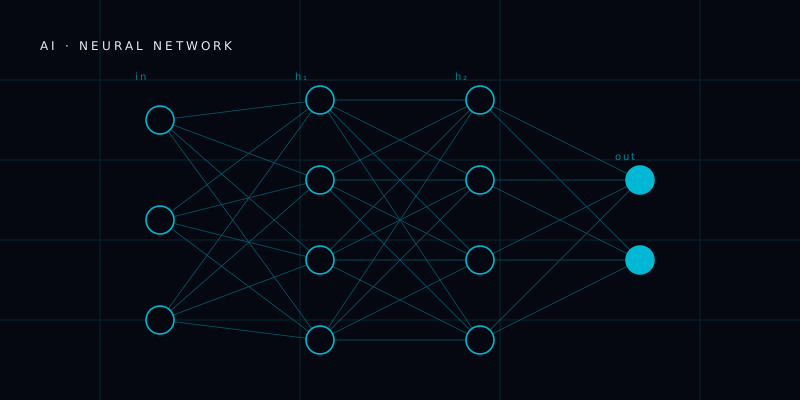
Offline reinforcement learning trains a policy purely from a fixed dataset of past experience — no live trial-and-error — letting robots learn from logged data safely, without the risky exploration standard RL requires.
Offline reinforcement learning learns a good policy from a pile of recorded experience, without the robot trying anything new during training. It's like learning to drive well by studying lots of driving logs, instead of practicing on the road.
🎯 Quick challenge
What distinguishes offline RL from standard (online) RL?
Standard reinforcement learning learns by doing — trying actions, seeing rewards, exploring. But for a real robot, live exploration is slow, expensive, and can be dangerous. Offline reinforcement learning offers an alternative: learn a good policy from recorded data alone.
The idea
Offline RL (also "batch RL") trains a policy entirely from a fixed dataset of previously-collected experience — logs of robots, humans, or older policies acting in the environment — without any new interaction during learning. The goal is ambitious: learn a policy that's better than whatever generated the data, purely by analyzing it. It's like learning to drive expertly by studying a massive archive of driving logs, without ever taking the wheel during study.
Learn from logs, don't explore live
No live trial-and-error during learning — the policy is squeezed out of a static dataset, then deployed. Safe and data-reusing, but tricky to do well.
Why it's valuable for robots
Safety. No risky exploration on real hardware or around people during training — a huge deal for robots.
Data reuse. Robots generate lots of logged experience (rosbags, fleet data). Offline RL turns that existing data into better policies without new data collection — very cost-effective.
Learning from humans and mixed sources. It can learn from demonstrations, past deployments, and heterogeneous logs together.
This makes it especially attractive for real-world robotics and autonomous driving, where online exploration is impractical.
The core challenge: distribution shift
Offline RL's central difficulty is subtle but severe. The learned policy might want to try actions the dataset never contains — and the value estimates for those unseen actions can be wildly, over-optimistically wrong (there's no data to correct them). The policy then chases these phantom high values and fails. So offline RL algorithms must be conservative: stay close to what the data supports, penalize out-of-distribution actions (methods like CQL, IQL). This is different from behavior cloning, which just copies the data — offline RL tries to improve on it while not straying beyond what the data can justify.
Where it fits
Offline RL — learn from a fixed dataset, no interaction. Safe, data-reusing.
Behavior cloning — a simple special case: just imitate the dataset's actions (no improvement, no value reasoning).
Model-based RL — can be done offline too (learn a model from the dataset, then plan).
Online RL — explore live; often offline RL pre-trains a policy that's then carefully fine-tuned online.
Why it matters
Offline reinforcement learning addresses a fundamental barrier to using RL on real robots: the danger and cost of live exploration. By learning from logged experience, it promises safe, data-efficient policy improvement from the data robots already produce — a key enabler for practical, real-world robot learning at scale.