What is a robot?
456 words · 3 min read · 2 sources
A robot is a machine that can sense the world, decide what to do, and act on its own — without a human guiding every move.
The concept concept: A robot is a machine that can sense
Difficulty 3/5 · ClassroomA robot is a machine that can sense the world, decide what to do, and act on its own — without a human guiding every move.
💡 Think of it like…
Think of it like a household object that does the same job — the underlying idea is the same, just adapted for robots.
🇮🇳 In India
The Tata Motors assembly line in Pune uses 500+ robots to build one car every 47 seconds.
Why it matters
Without what is a robot?, many concept systems in robotics simply couldn't work.
🤯 There are now more industrial robots working on Earth than there are people in Australia.
🎯 Quick challenge
Which three things must a machine have to be called a robot?
A robot is a machine that can sense the world, decide what to do, and act on its own — without a human guiding every move.
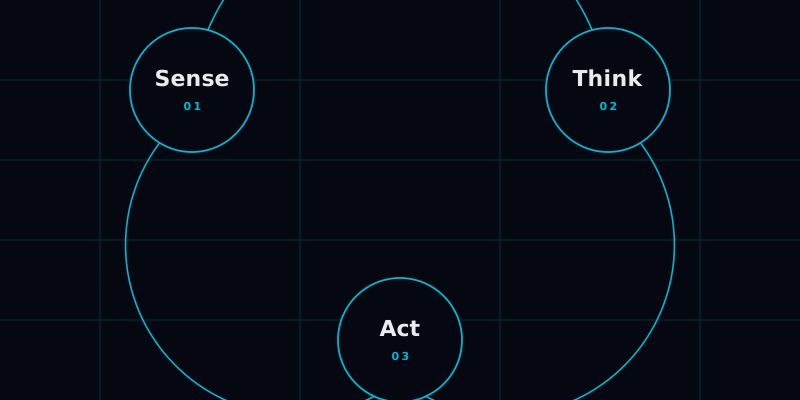
That definition has three parts, and every robot — from a Roomba to a Mars rover — has all three.
The three parts of every robot
It senses. A robot takes in information about its surroundings using sensors — cameras, microphones, distance detectors, accelerometers, temperature sensors. A washing machine that just runs on a timer isn't a robot. A washing machine that detects load weight and adjusts the spin cycle? That edges into robot territory.
It decides. A robot has a brain — usually a small computer called a microcontroller or, in bigger robots, a full Linux computer. The brain takes the sensor data and decides what to do next. This is where things like artificial intelligence, control loops, and programming live.
It acts. A robot has actuators — motors, servos, pistons, fans, speakers — that change something in the world. A robot that only "thinks" but doesn't move or affect anything is just a computer.
Why the line gets fuzzy
Is your phone a robot? It senses (camera, mic, GPS), it decides (apps, AI), and it acts (it talks, vibrates, shines its flashlight). By a strict reading, yes. Most people would say no — partly because we don't expect it to operate independently of us. The strict engineering definition keeps creeping wider; the everyday definition stays narrow.
The clearest robots are the ones that move physical things in the world by themselves: factory arms, drones, vacuum cleaners, surgical machines, self-driving cars, walking humanoids.
The history in one paragraph
The word robot comes from the Czech play R.U.R. by Karel Čapek (1920). The first real industrial robot — Unimate — was installed at a General Motors plant in 1961, where it lifted hot car parts out of die-casting machines so humans wouldn't have to. Since then, robots have spread into surgery, space (every Mars rover is a robot), warehouses, oceans, kitchens, and now homes — in the form of humanoid robots like Tesla's Optimus and Figure 03.
So what makes a good robot?
A good robot does three things well together: it perceives accurately, it decides quickly, and it acts safely. Getting any one of those wrong — a self-driving car that misreads a stop sign, a surgical arm that decides too slowly, a humanoid that falls on a child — and the whole machine fails, even if the other parts work perfectly. That's why robotics is hard: it's three difficult problems stitched into one.
Curious what's inside the brain of a modern robot? Read SLAM — how robots build mental maps of places they've never been.
Ask R2 Co-pilot anything you didn't understand about What is a robot?. It'll explain it plainly.
Keep going
Atlas (Boston Dynamics)
Atlas is Boston Dynamics' bipedal humanoid robot — the most acrobatic robot ever built, and now an electric ma…
ConceptLidar
Lidar is a sensor that measures distance by firing invisible laser pulses and timing how long they take to bou…
RobotOptimus (Tesla)
Optimus is the humanoid robot Tesla is building to do general-purpose work — in their factories first, and eve…
Last updated · 2026-05-19
Community discussion
0 questions & insightsLoading discussion…
Spotted something off? Report an error →