Robotics
480 words · 3 min read · 2 sources
Robotics is the field that designs, builds, and programs machines capable of carrying out physical tasks automatically or semi-automatically — blending mechanics, electronics, and software into a single discipline.
The concept concept: Robotics is the field that designs, builds, and
Difficulty 3/5 · ClassroomImagine a factory floor at three in the morning. The lights are dim, every human has gone home, and yet metal arms are swinging, welding torches are firing, and conveyor belts keep moving. Nobody told those arms to start or stop — they just do it, hour after hour, with the same precision on the thousandth part as on the first. Now ask: what field of knowledg
💡 Think of it like…
Think of it like a household object that does the same job — the underlying idea is the same, just adapted for robots.
Why it matters
Without robotics, many concept systems in robotics simply couldn't work.
Imagine a factory floor at three in the morning. The lights are dim, every human has gone home, and yet metal arms are swinging, welding torches are firing, and conveyor belts keep moving. Nobody told those arms to start or stop — they just do it, hour after hour, with the same precision on the thousandth part as on the first. Now ask: what field of knowledge made that possible?
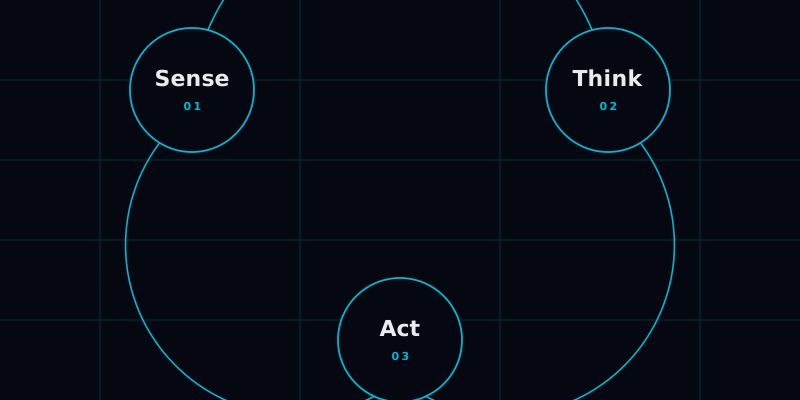
That field is robotics — the science and engineering of machines that sense the world, think about what to do, and then act on it physically. The word comes from the Czech robota, meaning drudgery or forced labour, coined by playwright Karel Čapek in his 1920 play R.U.R.. But modern robotics is far less dystopian than Čapek imagined: it is fundamentally a discipline about giving machines useful physical agency.
Three pillars, one discipline
Robotics sits at the intersection of three older fields. Mechanical engineering provides the body — structures, joints, actuators, and materials that let a machine move and exert force. Electrical and electronics engineering provides the nervous system — sensors, motors, power circuits, and microcontrollers that perceive and respond. Computer science provides the mind — algorithms, control loops, and increasingly, machine-learning models that decide what to do with all that sensory information.
No single pillar is sufficient alone. A beautifully machined arm that cannot sense is blind. A clever algorithm with no body is just software. Robotics is what happens when all three come together.
A field wider than factory arms
The word "robotics" covers an enormous range: surgical robots that perform incisions smaller than a human hand can manage, deep-sea exploration vehicles that map hydrothermal vents, autonomous tractors that navigate wheat fields by GPS, and soft robots made of silicone that squeeze through earthquake rubble. What they share is the sense-think-act pattern — perceive the environment, process that information, take a physical action.
The International Federation of Robotics estimated that roughly 3.9 million industrial robots were operating worldwide in 2023, a number that grows every year as costs fall and software matures.
Why it matters
Robotics matters because there are environments and tasks that are dull, dirty, dangerous, or simply physically impossible for humans. A robot can weld for sixteen hours without fatigue, enter a nuclear reactor without radiation risk, or operate on the surface of Mars without a life-support system. Equally, a surgical robot can guide a scalpel through a three-millimetre incision with sub-millimetre accuracy that no human hand, however skilled, can reliably repeat ten thousand times.
Understanding robotics means understanding the principles — sensing, actuation, control, and autonomy — that every robot in every domain draws on.
If robots can already do so much, what is the one capability that still reliably separates a human worker from even the most advanced machine on the factory floor today?
Ask R2 Co-pilot anything you didn't understand about Robotics. It'll explain it plainly.
Keep going
A* (A-Star) Pathfinding in Robotics — Complete Guide
A* finds the shortest path between two points on a grid or graph. It is the most-used pathfinding algorithm in…
ConceptAccelerometer in Robotics — Complete Guide
An accelerometer measures linear acceleration along an axis. In robotics, accelerometers detect motion, tilt, …
ConceptActuator
The muscles of a robot — devices that convert electrical or pneumatic energy into mechanical motion.
Last updated · 2026-05-19
Community discussion
0 questions & insightsLoading discussion…
Spotted something off? Report an error →