Stepper motor
533 words · 3 min read · 3 sources
A stepper motor moves in precise, discrete jumps rather than continuous rotation, letting a robot know exactly where it is without needing a position sensor.
The concept concept: A stepper motor moves in precise, discrete jumps
Difficulty 3/5 · ClassroomThink of a clock with a sweeping second hand versus one that ticks in crisp, audible jumps. A regular DC motor is the sweeping kind — smooth but hard to position exactly. A stepper motor is the ticking kind. Every electrical pulse moves it by a fixed, predictable angle, and it stops there, holding its position against gentle resistance.
💡 Think of it like…
Think of it like a household object that does the same job — the underlying idea is the same, just adapted for robots.
Why it matters
Without stepper motor, many concept systems in robotics simply couldn't work.
Think of a clock with a sweeping second hand versus one that ticks in crisp, audible jumps. A regular DC motor is the sweeping kind — smooth but hard to position exactly. A stepper motor is the ticking kind. Every electrical pulse moves it by a fixed, predictable angle, and it stops there, holding its position against gentle resistance.
That ticking behaviour is the whole point. A stepper motor divides a full rotation into a fixed number of discrete steps — typically 200 steps per revolution, or 1.8° per step — by using a rotor with many small teeth and a set of coils that pull those teeth into alignment one group at a time. The controller pulses the coils in a precise sequence, and each pulse advances the rotor by exactly one step.
How it works
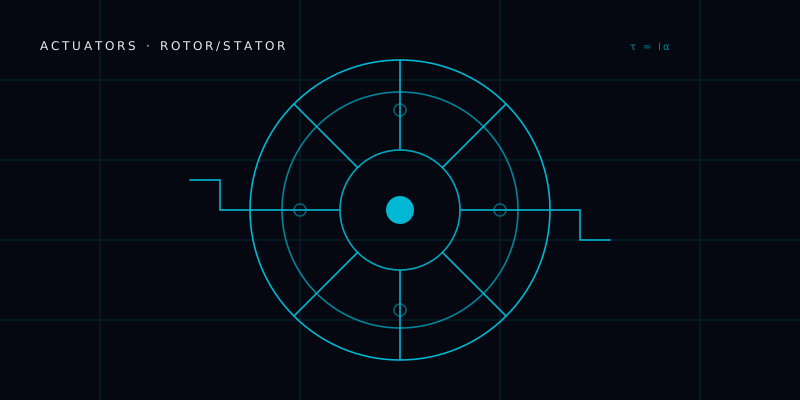
The rotor of a stepper motor is made of a magnetically soft material machined into small teeth, or of permanent magnets arranged in a toothed pattern. Surrounding it are several electromagnet coils arranged in groups called phases. When a controller energises phase A, the nearest rotor teeth align with phase A's poles and lock there. Energise phase B next, and the closest teeth snap to phase B — advancing the shaft by one step. March through all the phases in sequence, and the motor turns continuously at whatever rate the pulses arrive.
Because the controller always knows how many pulses it has sent, it always knows the shaft angle — no separate position sensor needed. This is called open-loop position control, and it is what makes stepper motors so popular: the control is in the software, not in expensive sensors.
The trade-off is torque at speed. Stepper motors have excellent holding torque (the force needed to push them off a position) but lose torque rapidly as step rate increases. Push them too fast and they stall, losing track of position entirely — a condition called losing steps, which is catastrophic if precise position is required.
Real-world example
The 3D printer on a school workbench almost certainly uses stepper motors. The Prusa i3 MK4, one of the most widely used desktop printers in the world, uses four NEMA 17 stepper motors — two for the Y-axis bed, one for the X-axis print head, and one for the extruder. Each layer of a print is a precise sequence of hundreds of thousands of pulses. The printer needs no encoders because it trusts the steps.
Why it matters
Stepper motors brought precision positioning into low-cost hardware. CNC machines, laser cutters, plotters, camera sliders, telescope mounts, and automated lab equipment all rely on steppers to move to a known position repeatably. They are the reason consumer 3D printing is affordable — a servo-based equivalent system would cost ten times as much. When a robot task needs exact, repeatable positioning without demanding high speed, the stepper motor is almost always the first choice.
The same open-loop logic that makes a stepper easy to control is also its weakness — research teams are now adding tiny encoders directly to stepper shafts to catch lost steps before they ruin a delicate operation.
Ask R2 Co-pilot anything you didn't understand about Stepper motor. It'll explain it plainly.
Keep going
A* (A-Star) Pathfinding in Robotics — Complete Guide
A* finds the shortest path between two points on a grid or graph. It is the most-used pathfinding algorithm in…
ConceptAccelerometer in Robotics — Complete Guide
An accelerometer measures linear acceleration along an axis. In robotics, accelerometers detect motion, tilt, …
ConceptActuator
The muscles of a robot — devices that convert electrical or pneumatic energy into mechanical motion.
Last updated · 2026-05-19
Community discussion
0 questions & insightsLoading discussion…
Spotted something off? Report an error →