PCB (printed circuit board)
442 words · 3 min read · 2 sources
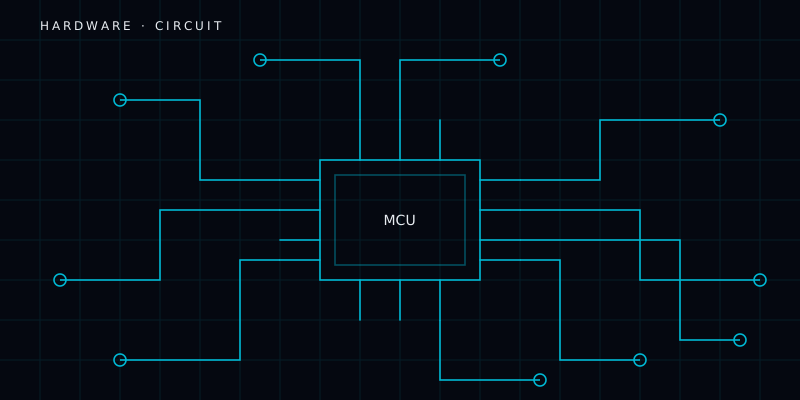
A PCB is a flat board of insulating material threaded with copper tracks that connect electronic components without wires — the backbone of almost every electronic device ever made.
The concept concept: A PCB is a flat board of insulating
Difficulty 3/5 · ClassroomOpen any electronic device — a mobile phone, a TV remote, a robot motor driver — and you will find a green (or sometimes blue, red, or black) board studded with chips, capacitors, and connectors. Thin copper lines snake between the components like invisible streets on a city map. That is a printed circuit board, and those copper streets carry the electricity
💡 Think of it like…
Think of it like a household object that does the same job — the underlying idea is the same, just adapted for robots.
Why it matters
Without pcb (printed circuit board), many concept systems in robotics simply couldn't work.
Open any electronic device — a mobile phone, a TV remote, a robot motor driver — and you will find a green (or sometimes blue, red, or black) board studded with chips, capacitors, and connectors. Thin copper lines snake between the components like invisible streets on a city map. That is a printed circuit board, and those copper streets carry the electricity that makes everything work.
A PCB (printed circuit board) is a flat, rigid board made of fibreglass-reinforced resin (called FR4 in most commercial boards) with copper pathways — called traces — etched directly into its surface. Components are soldered onto the board at specific pads, and the traces electrically connect them according to a design called a schematic. The result replaces what would otherwise be a rat's nest of individual wires.
How a PCB is made
The process starts with a sheet of copper-clad fibreglass. A designer uses software (KiCad, Altium, Eagle) to draw the schematic and route the traces. The design is sent to a fabrication house. There, the copper is chemically etched away everywhere it is not needed, leaving only the intended traces. Holes are drilled for through-hole components; flat pads are left for surface-mount components. A layer of solder mask (the green coating) protects the copper from oxidising and prevents accidental solder bridges. Silkscreen labels (white text) identify each component.
Layers and complexity
Simple hobby boards are two-layer: copper on top, copper on the bottom. A smartphone motherboard may have 12 or more layers of copper sandwiched in the fibreglass, each carrying different signals — power, ground, data — without interfering with each other. Connections between layers pass through tiny drilled holes called vias.
Why PCBs matter in robotics
Every robot has at least one. The motor driver board, the power management board, the sensor breakout board, the main compute board — all PCBs. Custom PCBs replace jumper-wire prototypes once a robot design is finalised, making it smaller, lighter, more reliable, and easier to reproduce. A well-designed PCB can mean the difference between a robot that runs for hours and one that drops a sensor connection every time it vibrates.
Designing your own PCB used to require professional training. Today, open-source tools and affordable fabrication services (JLCPCB in Shenzhen, for example, will make five two-layer boards for a few dollars) have put it within reach of students and hobbyists.
The world's first recognised printed circuit board patent was filed by Austrian engineer Paul Eisler in 1943 while he was working in a London bedsit — he invented it partly to make a working radio more compact.
Ask R2 Co-pilot anything you didn't understand about PCB (printed circuit board). It'll explain it plainly.
Keep going
A* (A-Star) Pathfinding in Robotics — Complete Guide
A* finds the shortest path between two points on a grid or graph. It is the most-used pathfinding algorithm in…
ConceptAccelerometer in Robotics — Complete Guide
An accelerometer measures linear acceleration along an axis. In robotics, accelerometers detect motion, tilt, …
ConceptActuator
The muscles of a robot — devices that convert electrical or pneumatic energy into mechanical motion.
Last updated · 2026-05-19
Community discussion
0 questions & insightsLoading discussion…
Spotted something off? Report an error →