Transfer learning
394 words · 2 min read · 2 sources
Transfer learning is a machine-learning technique where a model trained on one task or dataset is reused as the starting point for a different but related task, dramatically reducing the data and compute needed to reach good performance.
The concept concept: Transfer learning is a machine-learning technique where a
Difficulty 3/5 · ClassroomA doctor who decides to become a lawyer does not go back to secondary school. They already know how to read technical documents, construct arguments, evaluate evidence, and stay calm under pressure. Medical school trained those general skills; law school applies them to a new domain. They are starting from a far more capable baseline than a fresh graduate, a
💡 Think of it like…
Think of it like a household object that does the same job — the underlying idea is the same, just adapted for robots.
Why it matters
Without transfer learning, many concept systems in robotics simply couldn't work.
A doctor who decides to become a lawyer does not go back to secondary school. They already know how to read technical documents, construct arguments, evaluate evidence, and stay calm under pressure. Medical school trained those general skills; law school applies them to a new domain. They are starting from a far more capable baseline than a fresh graduate, and they get competent much faster because of it.
Transfer learning applies the same logic to machine-learning models. Instead of training a new model from random initial values for every new task, you start from a model already trained on a large dataset — where it has learned general, broadly useful representations — and fine-tune it on your specific task. The pretrained model's knowledge transfers.
Why it works
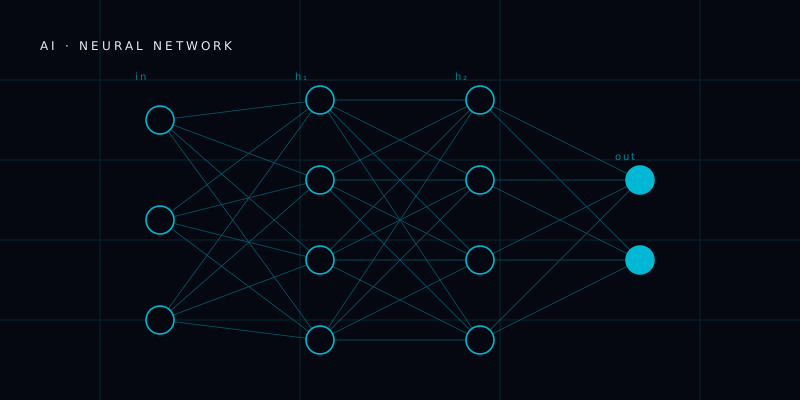
In a deep neural network, early layers tend to learn general features that are useful across many tasks: edges and textures in image models, grammar and word relationships in language models. Later layers learn task-specific patterns. Transfer learning keeps the general early-layer knowledge and retrains the later layers for the new task.
The standard workflow
- Take a large pretrained model — for images, something like ResNet or ViT, trained on ImageNet's 1.4 million labelled photos; for language, a transformer trained on a vast text corpus.
- Replace or add a task-specific head (the final output layers).
- Fine-tune on your own dataset, which may be far smaller than the original training data.
A real example
A robotics company wants to train a camera-based quality-inspection system for a circuit-board factory. They have only 800 labelled images of defective boards. Training a deep network from scratch on 800 images would produce a poor model. Using a network pretrained on ImageNet as the base, they fine-tune with their 800 images and reach high accuracy — because the network already knows how to see.
Why it matters for robotics
Robotics datasets are expensive to collect. Transfer learning lets teams build on the vast visual and linguistic knowledge baked into large pretrained models instead of starting every project from zero. This is one reason foundation models have become so central to robotics research.
When a model trained on internet text can, with modest fine-tuning, control a robot arm — the boundary between language understanding and physical action starts to blur.
Ask R2 Co-pilot anything you didn't understand about Transfer learning. It'll explain it plainly.
Keep going
A* (A-Star) Pathfinding in Robotics — Complete Guide
A* finds the shortest path between two points on a grid or graph. It is the most-used pathfinding algorithm in…
ConceptAccelerometer in Robotics — Complete Guide
An accelerometer measures linear acceleration along an axis. In robotics, accelerometers detect motion, tilt, …
ConceptActuator
The muscles of a robot — devices that convert electrical or pneumatic energy into mechanical motion.
Last updated · 2026-05-19
Community discussion
0 questions & insightsLoading discussion…
Spotted something off? Report an error →