Humanoid robot
410 words · 3 min read · 1 source
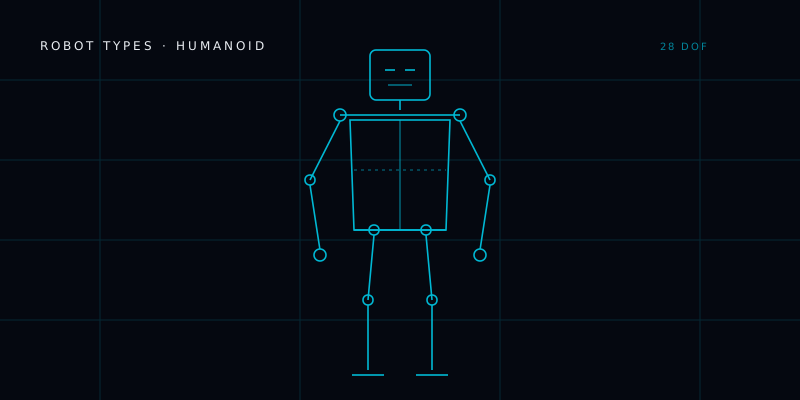
A humanoid robot is a robot built in the rough shape of a human body — two legs, two arms, a head with cameras. It's the hardest robot shape to build, and possibly the most useful.
The concept concept: A humanoid robot is a robot built in
Difficulty 3/5 · ClassroomA humanoid robot is a robot built in the rough shape of a human body — two legs, two arms, a head with cameras. It's the hardest robot shape to build, and possibly the most useful.
💡 Think of it like…
Think of it like a household object that does the same job — the underlying idea is the same, just adapted for robots.
Why it matters
Without humanoid robot, many concept systems in robotics simply couldn't work.
A humanoid robot is a robot built in the rough shape of a human body — two legs, two arms, a head with cameras. It's the hardest robot shape to build, and possibly the most useful.
Why bother making robots human-shaped?
The world is designed for humans. Door handles are at hand height. Stairs are sized for feet. Chairs, tools, vehicles — all assume a human-shaped operator. A robot in the same shape can use them all without redesigning anything.
The economic argument is stronger than it sounds. The alternative is to redesign every workplace and home around specialised robots. That's expensive at small scale and politically impossible at large scale. A humanoid that can use existing infrastructure is, in theory, infinitely deployable.
Why it's so hard
Balance. Two legs is the unstable case. Four legs is stable (it's static). Two legs is dynamic — you're falling forward and catching yourself with every step. This is the problem Marc Raibert and Boston Dynamics spent 30 years solving.
Mass. A humanoid is top-heavy — most of the weight is in the torso. Tipping over is constant risk.
Energy. Walking is energy-hungry. Current humanoid batteries last 1-4 hours.
Hands. A human hand has 22+ degrees of freedom. A robotic equivalent has 5-22 degrees of freedom and roughly 1/100 the dexterity. Hands are the bottleneck on what humanoids can actually do.
Cost. A high-end humanoid in 2026 still costs $20,000-$200,000. For most jobs, that's hard to justify against a $30,000-a-year human.
Who's making them
The 2026 humanoid race has roughly seven serious players:
- Tesla Optimus — the volume bet, target $20-30k
- Figure — the enterprise bet (Figure 02, Figure 03)
- Boston Dynamics — Atlas (electric, Hyundai factories)
- 1X — NEO, focused on home use
- Agility Robotics — Digit, focused on warehouses
- Unitree — H1, the price-disrupter from China
- Apptronik — Apollo, partnered with Mercedes
There are 30+ others in stealth or early stage.
What humanoids are good at today (2026)
- Pick-and-place in structured environments
- Walking on flat or modestly uneven ground
- Mimicking a human demo via teleoperation
- Looking cool on YouTube
What they're still bad at
- Anything unrehearsed
- Stairs (especially descending)
- Long-duration tasks (battery)
- Anything requiring fine dexterity in hands
- Operating safely near children, pets, or unpredictable people
Curious what specifically changed between Optimus Gen 2 and Gen 3? Read Tesla Optimus walking explained in 4 min.
Ask R2 Co-pilot anything you didn't understand about Humanoid robot. It'll explain it plainly.
Keep going
Atlas (Boston Dynamics)
Atlas is Boston Dynamics' bipedal humanoid robot — the most acrobatic robot ever built, and now an electric ma…
RobotOptimus (Tesla)
Optimus is the humanoid robot Tesla is building to do general-purpose work — in their factories first, and eve…
ConceptReinforcement learning (for robots)
Reinforcement learning is how you teach a robot a skill by letting it try millions of times, rewarding it when…
Last updated · 2026-05-19
Community discussion
0 questions & insightsLoading discussion…
Spotted something off? Report an error →